

The players on the Cal State LA women’s basketball team are required to drop dimes.
The kinds of assists that are expected of them are not on the court, but in the neighborhoods that Cal State LA serves, where the players have become visible custodians of the community.
On any given weekend, the team can be found out and about in the greater Los Angeles area providing volunteer work that positively impacts the community.
“There’s a debt to pay to society,” said Torino Johnson, head coach of the team. “The community service is like a field trip. You’re getting the lowdown, getting to know the people that you serve. Wherever there’s a need, we want to be the face that shows up. We don’t want to sit idly by as homelessness skyrockets or as the opioid crisis worsens. We try to get out front and say, ‘Hey, we’re here, you can count on us.’”
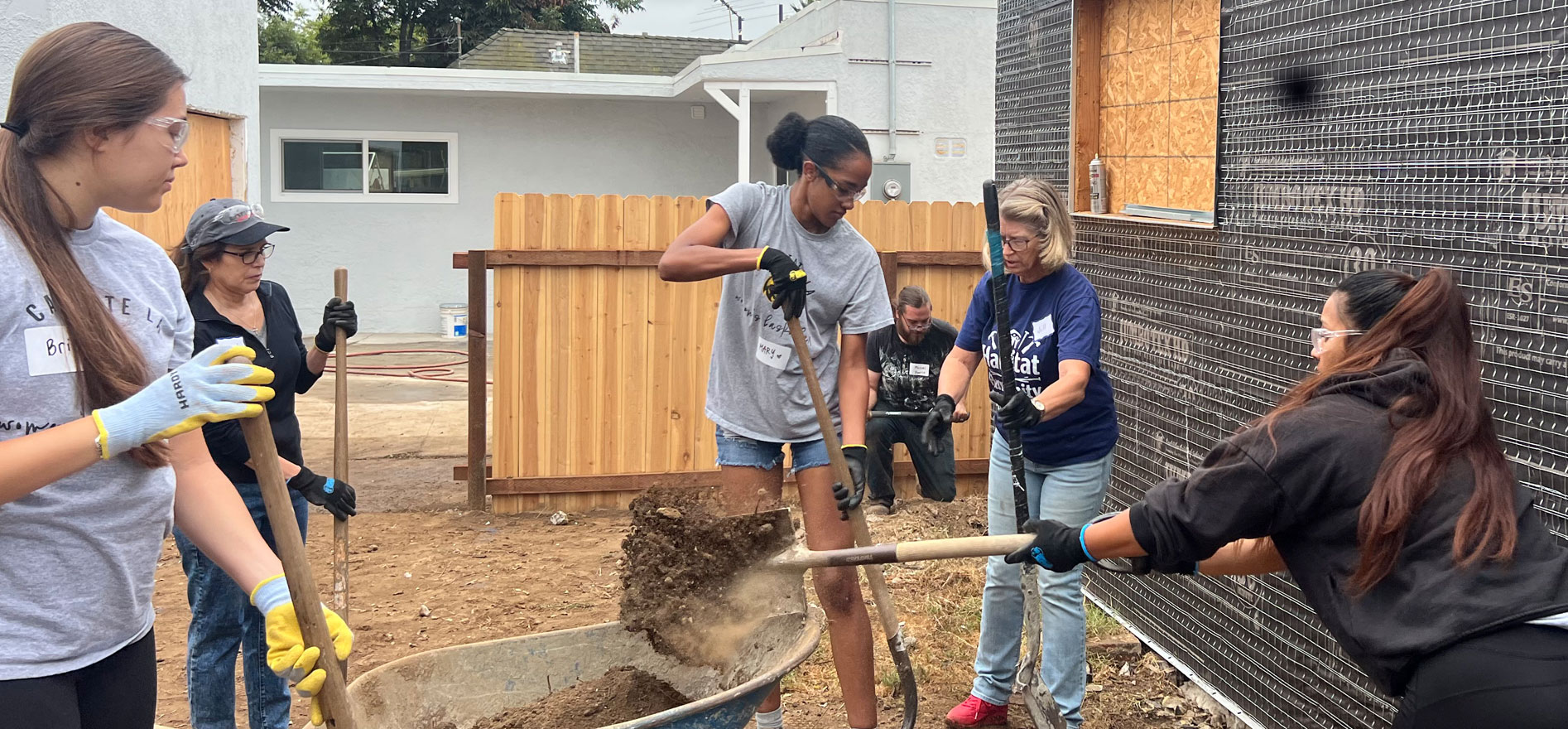
During the fall 2025 semester, the Golden Eagles leveled the foundation and moved about a ton of dirt at an El Sereno home through Habitat for Humanity, assembled care packages with the Los Angeles Regional Food Bank, collected trash off the streets of Koreatown in collaboration with the Koreatown Youth and Community Center, cooked 150 “Meals of Love” for families staying temporarily at the Ronald McDonald House in Los Angeles, and more.
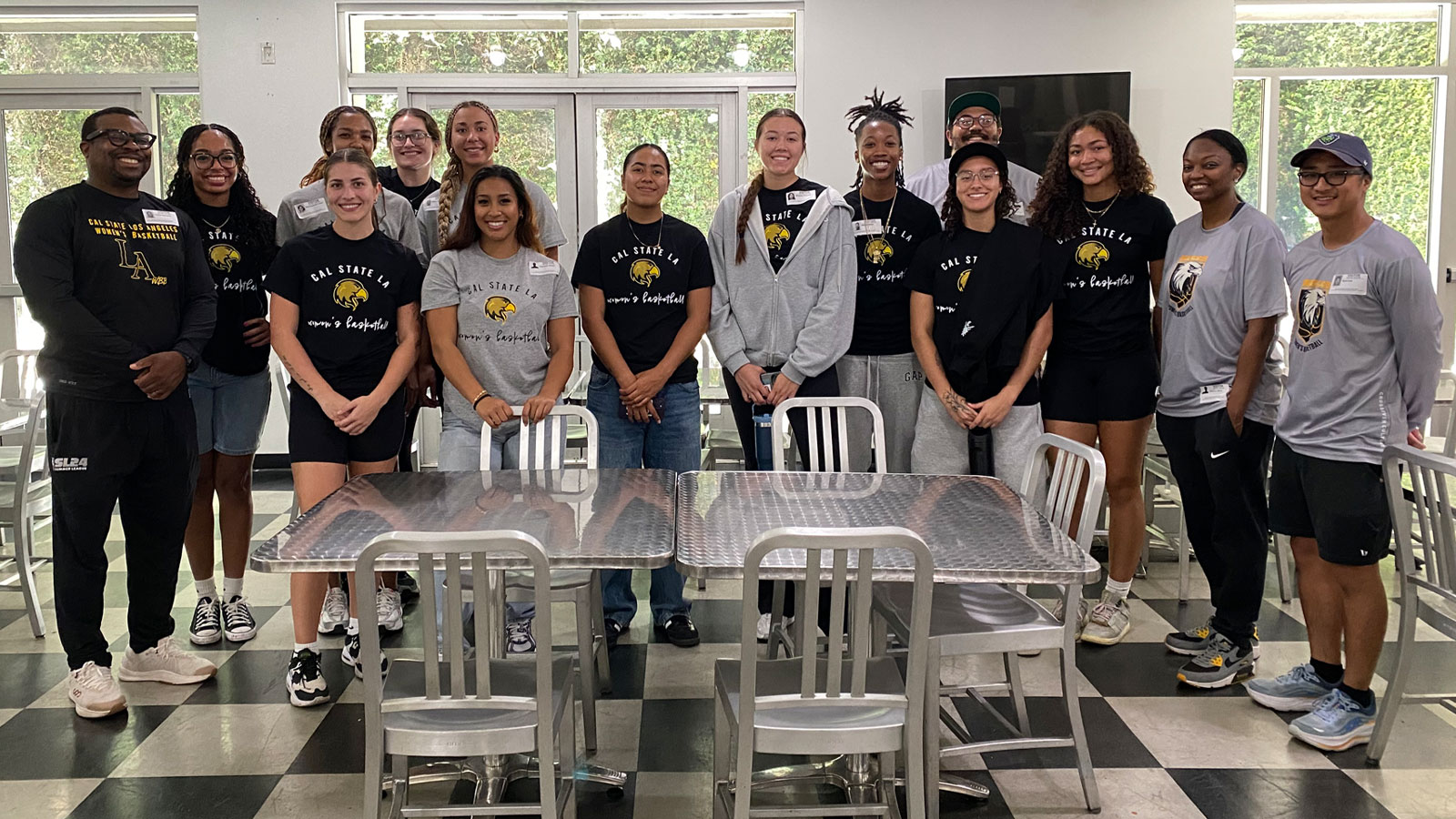
Photo: The Cal State LA women's basketball team's players and coaches prepared 150 "Meals of Love" for guests at the Ronald McDonald House in Los Angeles.
Johnson implemented the mandatory volunteer work when he took over the program seven seasons ago as a way for his players— and assistant coaches—to take ownership of their community.
The players have embraced the idea.
“These are opportunities that are once in a lifetime,” said junior guard Sofia Fidelus. “Yes, it looks good on a résumé, but more importantly it’s good for us. It feels good at the end of the day knowing you have given back.”
“I grew up doing quite a bit of volunteering. I like that it’s such a big part of the basketball program.
Johnson implemented the mandatory volunteer work when he took over the program six seasons ago as a way for his players—and assistant coaches—to take ownership of their community.
The players have embraced the idea.
“These are opportunities that are once in a lifetime,” said sophomore Sofia Fidelus. “Yes, it looks good on a resume, but more importantly it’s good for us. It feels good at the end of the day knowing you have given back.”
Said senior point guard Nevaeh Asiasi, “I’m grateful to be in a position where I can give back along with my teammates. We’re really close on the court, but getting the experience to be outside with them, working hard, sharing experiences, getting to know my teammates, getting to know myself—overall, it’s a blessed feeling.”
The Golden Eagles participate in 10-15 volunteer opportunities every year, Johnson estimates. Their season of giving never ends.
It all starts in the fall, way before the players set foot on the hardwood to compete.
Senior forward Amaya Fuentes said that the timeline allows the team to coalesce organically.
“We start the volunteer work before we really know each other,” she said. “We spend a lot of time together every weekend after already spending a lot of time together on weekdays. It’s our version of team bonding that we don’t necessarily have to plan. We just hang out with each other, and it’s all very natural.”
Freshman forward Jocelynn Townsend has learned plenty about her fellow Golden Eagles.
“We volunteer every Saturday, and that just speaks a lot about our personalities, our character, and what’s important to us as
a team,” she said. “It’s definitely shown me that my teammates are empathetic and very kind-hearted. When I was looking for a college, I wanted to be part of a team that is family-oriented, and this is definitely that team.”
“It’s our version of team bonding that we don’t necessarily have to plan. We just hang out with each other, and it’s all very natural.”
Embracing the Culture
Fidelus, who grew up in Northern California, says the volunteer work was instrumental in helping her acclimate to her new home.
“Being from the Bay Area, it’s so different from here,” she said. “There are two completely different cultures, and our coaches want us to immerse ourselves in the LA culture. I think the best way to get to know a place is to go in there and do the work.”
The volunteer opportunities are full of lessons that can be applied to the basketball court, according to Johnson. This year’s work with Habitat for Humanity, for example, did not go as planned.
The team had fully expected to paint the exterior of a house,
just as it did the previous year, but rain from the previous night prevented the players from taking paintbrushes to the home’s damp exterior walls.
Habitat for Humanity organizers pivoted to a more difficult, physically demanding task. They gave players pickaxes, shovels, and wheelbarrows and asked them to remove about four inches of dirt that had accumulated around the perimeter of the house.
The players rolled up their sleeves and completed the work without any complaints.
“You don’t prepare for a season expecting everything to go well; you prepare for adversity,” Johnson said. “We want to find ways to look at any problem as a simple opportunity to learn. We want to give them a chance to grow.”
Johnson’s relationship with Habitat for Humanity dates back more than a decade to his days as the coach at Palisades Charter High School, which Johnson built into a state powerhouse. Even then his players were volunteering with the nonprofit.
“There’s always going to be a need for volunteers, and we’re going to put up our hands and say, ‘Pick us.’"
Success On and Off the Court
A native Angeleno, Johnson said the volunteer ethic was instilled in him as a child when his mother would take him to various soup kitchens where they would provide service. He counts himself lucky to have a staff that also believes in paying it forward, and now they are passing it down to their players.
“I don’t want them to think we’re just coaching them physically,” Johnson said. “From the neck up, we want to help them grow into thoughtful individuals who are aware that in Los Angeles, although COVID-19 is over, there are different levels of pandemics going on at all times.”
Johnson has transformed Cal State LA into one of the top programs in the California Collegiate Athletic Association (CCAA) and the NCAA West Region. The Golden Eagles have made four straight CCAA Tournament appearances for the first time in program history, and their 55 victories over the past three seasons are the most since the 2012-14 seasons.
The coach says the team strives to duplicate its success off the court.
“You’re going to see us with Habitat for Humanity. You’re going to see us with the Koreatown Youth and Community Center, and the Los Angeles Regional Food Bank,” Johnson said. “All of these opportunities around LA give us a chance to form a coalition, a partnership with people who need help. There’s always going to be a need for volunteers, and we’re going to put up our hands and say, ‘Pick us.’ We have affable, incredible young women who are going to be our next generation of leaders. Exposing them to society’s most vulnerable puts them in a position to have empathy and understanding for those in need.”