

Tucked behind the walls of the California Institution for Men (CIM) in Chino, about 30 miles east of Cal State LA’s main campus, a quiet revolution is underway.
It looks modest at first glance—a single-story building, a patch of lawn. But step inside and you will find something extraordinary: the nation’s first campus solely dedicated to offering a bachelor’s degree program to incarcerated students. It is the latest milestone in Cal State LA’s Prison Graduation Initiative (PGI), and a vivid example of how the University is transforming lives and empowering dreams, even in the most unlikely of places.
“This new facility for PGI’s bachelor’s degree program represents the strength of our ongoing partnership with CIM and the California Department of Corrections and Rehabilitation (CDCR),” said President Berenecea Johnson Eanes. “Cal State LA is in it for the long run. This is what we do.”
Launched in 2016, PGI was the first in-person bachelor’s degree completion program in a California prison. It has since graduated more than 70 students and changed the trajectory of dozens of lives. Now, with the opening of the CIM College Campus, the program is entering a new chapter rooted in innovation, rehabilitation, and human dignity.
From Ruins to Renaissance
What is now a fully functioning academic space complete with three classrooms, tutorial spaces, and faculty offices was once a crumbling, abandoned building. Previously used for parole, the structure had holes in the floors and open ceilings that let in rain and sunlight.
Thanks to funding from CIM and a two-year renovation effort, it has been reborn as a college campus unlike any other.
“This campus is more than a collection of rooms and materials,” said PGI student Lenin Montenegro, 55. “It’s a place where students like me and many more who will follow can deepen our understanding, expand our horizons, and get away from the distractions of incarceration.”
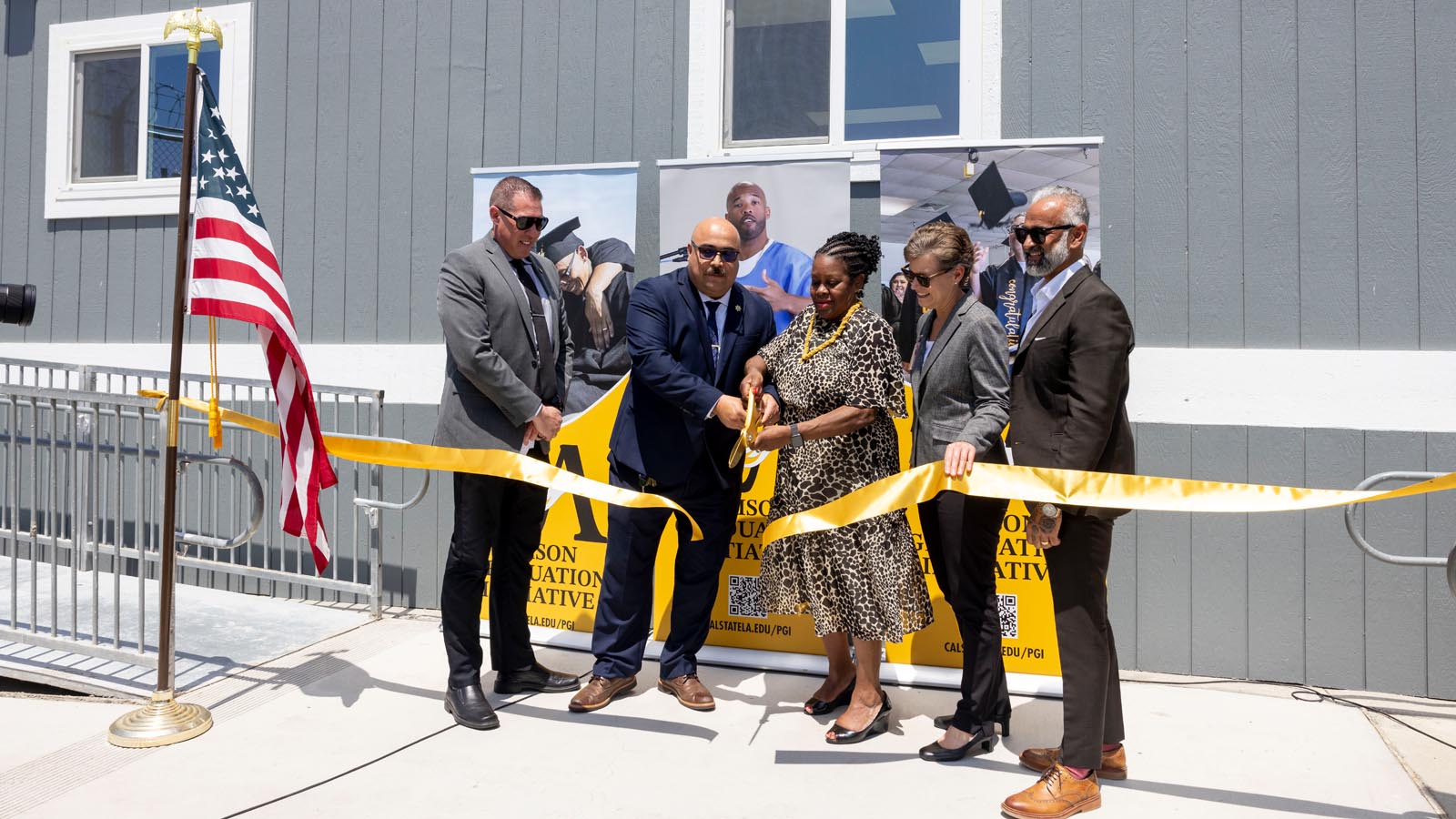
Photo: California Institution for Men’s (CIM) Associate Director Travis Pennington, far left, and Warden Eric Mejia join Cal State LA President Berenecea Johnson Eanes, Provost Heather Lattimer, and Prison Graduation Initiative Director Bidhan Roy for the ribbon-cutting ceremony at the CIM College Campus.
A Model for Change
The Chino campus is more than a bold expansion of PGI, it is also the first to embody the California Model of incarceration. Inspired by the Norway Model’s progressive approach to rehabilitation, the California Model aims to build safer communities through education, reentry preparation, and humane treatment.
Among its key principles:
- Normalization: Classrooms replicate non-prison environments to ease reentry into society
- Dynamic security: Emphasizes positive relationships and respectful communication between staff and incarcerated individuals
- Peer mentorship: Trains students to support one another through shared experiences
- Trauma-informed care: Recognizes and addresses the lasting effects of trauma on both staff and students
“Norway doesn’t have Cal State LA,” said PGI Director Bidhan Roy, who has studied the Norwegian system closely. “They don’t have B.A. programs. There are things happening in California that are not happening anywhere else. We should be proud to be part of that change.”
"...There are things happening in California that are not happening anywhere else. We should be proud to be part of that change.”
Education as a New Beginning
CIM’s inaugural PGI cohort has 66 students working toward a Bachelor of Arts in Liberal Studies. This is the program’s largest to date. Many are transfers from other institutions across the state. One of them is Eric Jones, 55, who earned an astounding 16 associate degrees during his incarceration.
“When I heard the bachelor’s program was finally starting here,” Jones said, “I knew all my hard work and patience was about to payoff.”
Every student in the cohort began their academic journey through distance learning with community colleges. But stepping into a real classroom brings new challenges and new growth. For many, it is their first experience with in-person learning.
“They’ve had isolated educational experiences,” Roy explained. “Now they’re learning how to ask questions, collaborate, and engage in group work, soft skills that are just as essential as academic ones.”
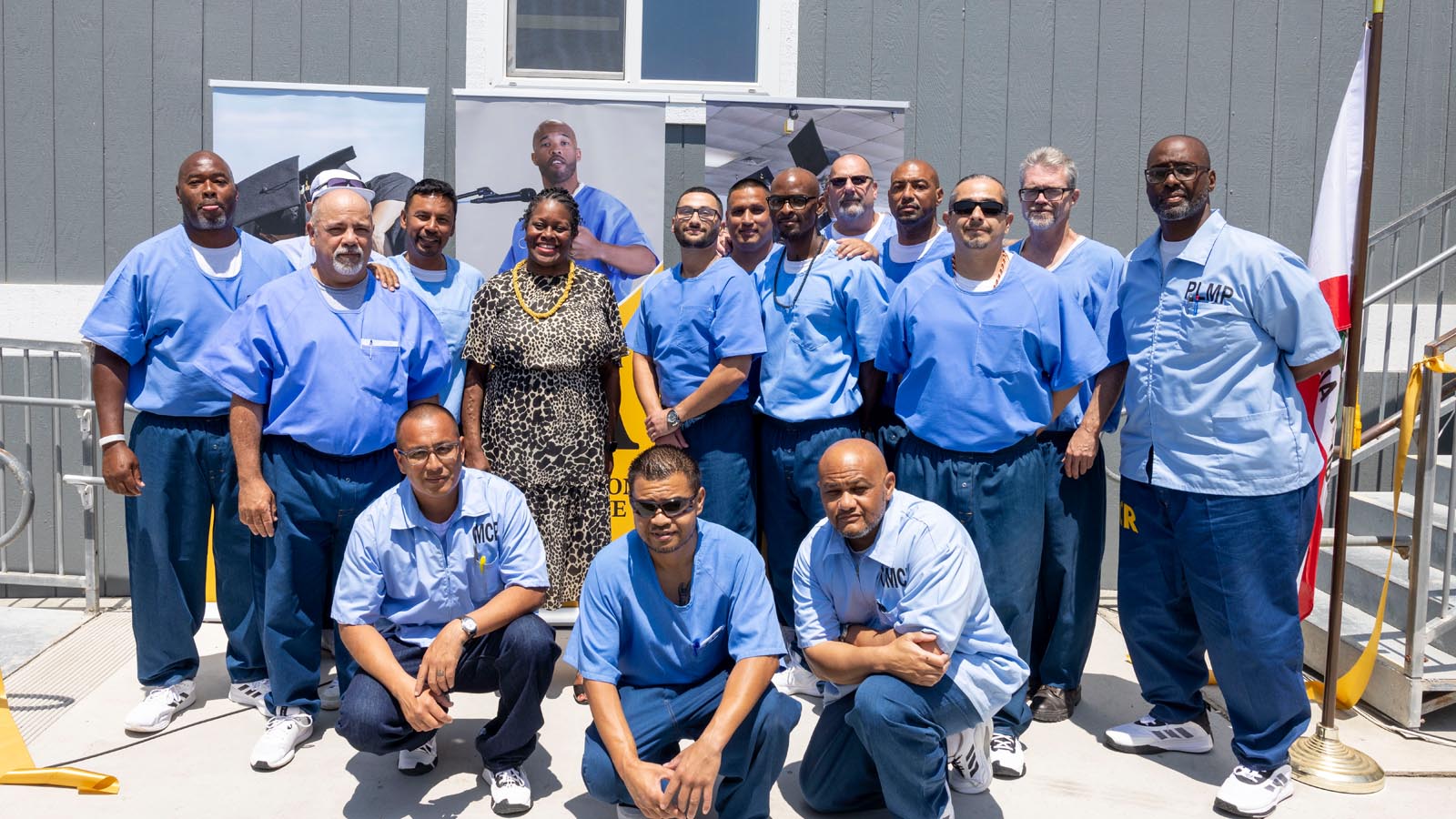
Photo: Cal State LA President Berenecea Johnson Eanes visits with members of the first Prison Graduation Cohort from the California Institution for Men at the new Chino campus.
Roy has watched older students struggle with technology, only to be tutored by their younger peers—moments that illustrate the collective spirit PGI is built upon.
“We try to build a cohort not just in the academic sense,” Roy said, “but as a community. They support each other. They grow together.”
The PGI students are preparing for more than graduation, they are preparing for life after incarceration, and the ordinary-yet- overwhelming realities of a world that has changed while they have been away. Something as simple as ordering at a restaurant or riding in a car can be disorienting after years of institutional routine.
“People get used to structure, and any shift in that is almost traumatic,” Roy said. “But growth requires discomfort. This campus helps students adjust and start to believe in a future outside these walls.”
And that belief, however small it may begin, is what changes lives.
“But growth requires discomfort. This campus helps students adjust and start to believe in a future outside these walls.”
A Place of Purpose
More than a new building, the CIM College Campus is a beacon of possibility. It represents what happens when a public university commits to serving all members of its community—even those behind bars.
It’s a space where dreams are not only imagined but nurtured. Where a second chance is earned through study, persistence, and mutual support. Where a University’s mission—to transform lives and empower dreams—takes physical shape, one classroom at a time.
“This is where futures will be built,” Montenegro said. “This is where change begins.”